

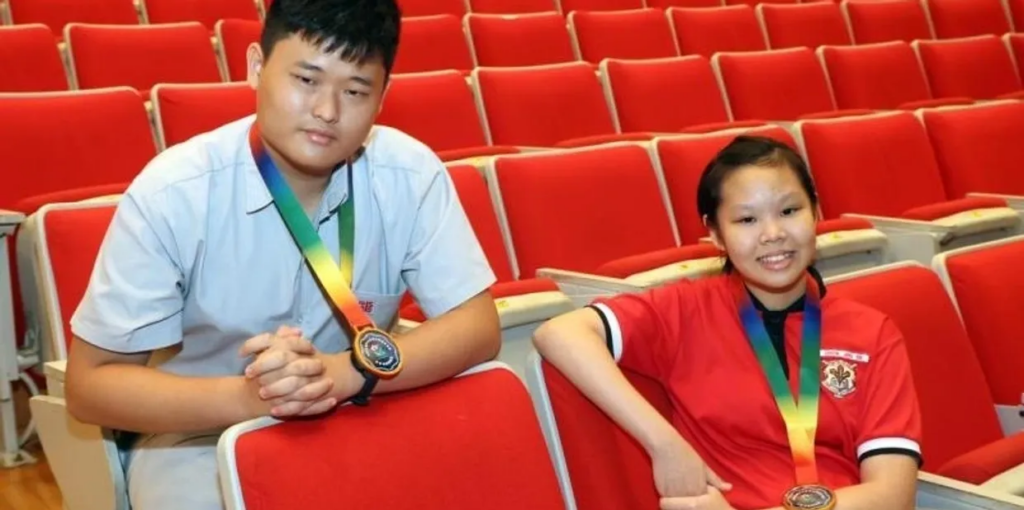
Xiao Jing’en (right), a Primary Six student from Yuzhi Primary School, and Yang Yicheng, a Secondary Three student from Jurong Secondary School, are among the awardees of the inaugural National Primary and Secondary School Chinese Reading Fun Competition. A total of 50 students received awards. (Photo by Kuang Qicong)
Can reading competitions leverage artificial intelligence too? The inaugural National Primary and Secondary School Chinese Reading Fun Competition has adopted AI technology, with AI supporting the entire process—from registration and question design all the way to judging. This not only brings a fresh, challenging vibe to the competition, but also makes the event fairer and more efficient.
The finals of the Chinese Reading Fun Competition will take place at Nanyang Girls’ High School on Saturday, 23 August.
July’s preliminary round drew 2,541 participants from 239 primary and secondary schools, with 135 students across both primary and secondary categories qualifying for the finals.
This competition is co-organised by the Committee for Promoting Chinese Language Learning and the Association for Research on AI in Learning and Leadership (formerly the Singapore Association for Artificial Intelligence in Language Education). Its objective is to spark students’ interest in reading, promote a Chinese reading culture, and help them develop good reading habits.
Dr. Chua Chee Lee, President of the Association for Research on AI in Learning and Leadership, shared in an interview that the competition adopted free registration. Organisers initially projected participation to range from 3,000 to 5,000 students.
“Managing this scale would have been impossible without support from our AI system. Traditional competitions usually see only two to three hundred participants, and handling larger numbers would be extremely challenging to manage manually.”
To address this, the organisers built an AI system to automate the entire competition workflow — covering registration, account and password generation, as well as preliminary round notification and event details.
The competition is split into five categories across primary and secondary levels, with 33 prescribed reading materials tailored to different age groups. These range from picture books for lower primary students, adapted versions of Journey to the West for Primary Three to Primary Six pupils, to Water Margin suited for upper secondary students. Participants are given two and a half months to complete their reading preparation ahead of the competition.
The preliminary round is held entirely online. Students log in to the system via their assigned accounts to complete the quiz. The primary category sits 20 multiple-choice questions, while the secondary category attempts 30. All preliminary scores are marked by AI.
In the finals, each category has an additional 10 questions. Results are assessed jointly by AI and teachers, with 10 winners selected from each category.
Dr. Chua Chee Lee revealed that the organising team fed all reading materials into a large language model, which generated more than 3,000 questions. These were then reviewed individually, with unsuitable entries removed to uphold the quality of the question bank.
To curb cheating in the preliminary round, each category has a pool of around 300 questions. Every student receives a unique set of questions and answer options, and their response time is also factored into the final score.
Liu Jiemin: Let reading become an indispensable part of life
Fifty award recipients received their prizes from Ms Low Yen Ling, Senior Minister of State for Education and the Ministry of Communications and Information, and Chairman of the Promote Mandarin Council, at the ceremony last Saturday.
In her address, Ms Low expressed hope that students would experience the joy and charm of reading through the competition, while nurturing a lifelong habit of reading Chinese texts.
“Let reading be more than just a competition — may it become an indispensable part of your daily lives.”
One of the award winners, 12-year-old Xiao Jing’en from Yuzhi Primary School — currently in Primary Six — shared that she read almost daily while preparing for the competition, and even made use of her school’s morning reading sessions to do so.
“The six prescribed reading materials were not difficult for me at all, as I already have a regular reading habit. This competition also helped me gain a deeper understanding of Journey to the West and motivated me to keep reading more widely.”
Another award recipient is 15-year-old Yang Yicheng from Jurong Secondary School, currently in Secondary Three. He first heard about the competition from his classmates and decided to sign up. While his peers did not advance past the preliminary round as they failed to complete all the reading materials, Yang kept to his schedule and finished all the prescribed readings.
He found Water Margin the most challenging of all the titles.
“The character relationships are intricate, the plot pace varies greatly, and each chapter centres on a different main character. It can be quite tough going if your Chinese proficiency is not strong enough.”
His approach is to first read the synopsis, then dive deeper into the story’s details.
(Reprinted from Lianhe Zaobao, Singapore)